Administration List
01Opportunity
02Timing
03Buyer Strategy
042027 Watchlist
05Real Examples
06Acquisition Brief
Back to top ↑
Planning acquisitions in 2027?
DOWNLOAD THE 2027 WATCHLIST PREVIEW TODAY
SIGNAL 01
BLACK FRIDAY 2026 · ACQUISITION INTELLIGENCE

The Business Buyer’sBlack Friday

How to Find Distressed Acquisition Opportunities Before Everyone Else

Everyone’s looking for deals.
We’re looking for businesses.

DOWNLOAD THE 2027 WATCHLIST PREVIEW TODAYREAD THE GUIDE ↓
Administration List2026Acquisition Strategy12 min read
START WITH THE SIGNAL ↓
THE PREMISE

Every Black Friday, millions of people go looking for deals.

They compare prices. Set alerts. Decide what they want before the sale starts. And when the right opportunity appears, they move quickly.

For business buyers, investors and acquisition professionals, there is a lesson in that behaviour.

Because some of the most interesting deals in the UK aren’t televisions, laptops or discounted trainers.

They’re businesses.

And unlike most Black Friday deals, the best distressed acquisition opportunities don’t necessarily arrive neatly packaged with a “Business for Sale” sign attached.

THE FIRST INDICATION MIGHT BE…
  • ▸a winding-up petition.
  • ▸a Notice of Intention to appoint administrators.
  • ▸a deterioration in financial performance.
  • ▸an administration where the valuable part of the business is still trading.

And sometimes the opportunity isn’t the company at all. It might be a brand, a customer book, a contract, a hotel, a piece of intellectual property, plant and machinery, stock or a portfolio of sites.

The challenge for buyers is knowing what to look for, where to look for it and when to act.

That is what this guide is about.

THE 2026 MARKET SNAPSHOTJAN–SEP 2026

The market hasn’t disappeared.
The route through distress is changing.

0
Recorded corporate distress cases
Jan–Sep 2026 · administrations, liquidations and winding-up petitions
−0.7%
Overall recorded distress, YoY.
Broadly stable. The mix underneath is not.
ADMINISTRATIONS ↑
0
+37.8%
PREV
1,142
2026
1,574
WINDING-UP PETITIONS
0
+4.5%
PREV
5,022
2026
5,249
LIQUIDATIONS ↓
0
−5.6%
PREV
14,621
2026
13,809

The volume hasn’t changed dramatically.
The route businesses are taking through distress has.

SOURCE: ADMINISTRATION LIST ANALYSIS, JAN–SEP 2026. RECENT FILING DATA CAN BE SUBJECT TO LATE-FILING REVISIONS.
WHAT CHANGED

Administrations increased 37.8%, from 1,142 to 1,574, while overall recorded distress was only 0.7% lower than the equivalent period in 2025.

BUYER TAKEAWAY · WHY A BUYER SHOULD CARE

Liquidation is often about realising assets after a business has reached the end of the road. Administration can create a very different situation: a business may still be trading, employing people, serving customers and fulfilling contracts while a restructuring or sale is explored.

The UK distressed market hasn’t disappeared. But the route through distress is changing.

Between January and September 2026, Administration List recorded 20,632 cases of corporate distress across administrations, liquidations and winding-up petitions.

That was only 0.7% lower than the equivalent period in 2025.

But underneath that relatively flat headline number, something more interesting happened.

Administrations increased 37.8%, from 1,142 to 1,574. Winding-up petitions increased 4.5%, from 5,022 to 5,249. Meanwhile, liquidations fell 5.6%, from 14,621 to 13,809.

For acquisition-minded buyers, that distinction matters.

Liquidation will often be primarily about realising assets after a business has reached the end of the road.

Administration can create a very different situation. A business may still be trading, employing people, serving customers, fulfilling contracts and operating from established premises while a restructuring or sale is explored.

And before either event, there can be earlier signs of financial pressure.

The lesson isn’t simply: “There are lots of insolvent companies.”

It’s: Understand the journey into distress, because different stages can create very different acquisition opportunities.

1OPPORTUNITY

The best distressed deals aren’t necessarily advertised as businesses for sale

A conventional acquisition search often begins with a fairly obvious question:

What businesses are currently for sale?

A distressed acquisition strategy can start somewhere else:

Which businesses are showing signs that something may be about to change?

That distinction can dramatically expand the universe you monitor.

A distressed acquisition strategy doesn’t have to start with “What’s for sale?”
It can start with “What’s changing?”

DISTRESS SIGNAL DICTIONARY

Different signals represent different points in the distressed acquisition journey.

EARLIER SIGNALFORMAL PROCESS →
DISTRESS SIGNAL
WUP
Early signal
Winding-up petition. A creditor action — not confirmation of liquidation.
DISTRESS SIGNAL
NOI
Potential administration signal
Notice of Intention to appoint administrators.
FORMAL EVENT
ADMINISTRATION
Formal process
Formal insolvency process. The business may still be trading.
FORMAL EVENT
LIQUIDATION
Asset realisation
Closure process. Stock, plant, IP or property may be realised.
FORMAL EVENT
PRE-PACK
A transaction may already have been structured
A sale arranged before formal appointment, completed shortly after.
SIGNAL→INVESTIGATE→FORMAL PROCESS→POTENTIAL OUTCOME

Winding-up petitions

DISTRESS SIGNAL

A winding-up petition is a serious creditor action asking the court to wind up a company because of an unpaid debt.

It is not confirmation that the company will ultimately be liquidated. The debt could be settled. The petition could be dismissed or withdrawn. The company could pursue another restructuring route.

But for an acquisition-minded buyer, it can be an important signal to investigate.

A company receiving a petition may still be trading, employing staff, operating sites, serving customers and holding commercially valuable assets.

That doesn’t mean it is available to buy. It means something has changed and it may be worth understanding what.

Notices of Intention

DISTRESS SIGNAL

A Notice of Intention to appoint administrators — often referred to as an NOI — can be another important signal.

An NOI can indicate that directors or qualifying floating-charge holders are considering administration.

Again, it isn’t a “for sale” notice.

But it may tell a prepared buyer that a business has entered a period where its ownership, structure or assets could potentially change.

Administration

FORMAL INSOLVENCY EVENT

Once administrators are appointed, the situation becomes more formal.

Depending on the circumstances, the business might continue trading while a buyer is sought. There could be a sale of the whole operating business, individual divisions, sites or selected assets.

For buyers, potential value could sit in:

  • customer relationships and contracts
  • brands and intellectual property
  • websites, domains and digital assets
  • stock
  • plant, vehicles and equipment
  • operating locations
  • accreditations or framework positions
  • specialist employees or operating teams

But administration itself does not mean that a company is automatically available for acquisition. Every case needs to be investigated individually.

Liquidation

FORMAL INSOLVENCY EVENT

By liquidation, the acquisition opportunity can look different again.

Rather than acquiring an operating company, buyers may be looking at stock, machinery, vehicles, property, intellectual property or other assets being realised.

For some acquisition strategies, that’s exactly where the opportunity lies. For others, it may already be too late.

Pre-pack administrations

FORMAL INSOLVENCY EVENT

And then there are pre-packs.

In a pre-pack administration, a sale of some or all of a company’s business or assets is negotiated before administrators are formally appointed and completed shortly after their appointment.

That can be frustrating if the first time you discover the company is in difficulty is when you read that the transaction has already happened.

Which brings us to one of the most important lessons for distressed business buyers.

THE DISTRESS JOURNEY

Different stages. Different questions. Different outcomes.

01SIGNAL
POSSIBLE EXAMPLES
  • Winding-up petition
  • NOI
  • Financial deterioration
  • Creditor pressure
02INVESTIGATE
BUYER QUESTIONS
  • What changed?
  • Which entity?
  • Still trading?
  • What creates value?
  • Who is advising?
03FORMAL PROCESS
POTENTIAL EVENTS
  • Administration
  • Liquidation
  • Restructuring
  • CVA
  • Pre-pack
04POTENTIAL OUTCOME
POSSIBLE OUTCOMES
  • Going-concern sale
  • Brand / IP acquisition
  • Asset purchase
  • Site acquisition
  • Restructuring
  • No transaction
SIGNAL
≠ SALE

A distress signal is a reason to investigate.
Not a reason to assume.

2TIMING

Your biggest advantage is often timing, not price

Distressed acquisition is often associated with buying cheaply. Sometimes price is part of the attraction.

But focusing only on price misses something arguably more important: time.

Imagine two buyers looking for the same type of company. Buyer A waits for businesses to formally enter administration and then begins looking.

ONE EVENT. TWO STARTING POINTS.TIME →
PREPARED BUYER · already working before the formal event
01Criteria already defined
02Continuous monitoring
03 · EARLY SIGNALSignal detected
04Investigation begins
05Situation develops
REACTIVE BUYER · waits for administration
Not yet looking. No signal seen.
01 · FORMAL EVENTAdministration
02Discovers company
03Begins research
04Identifies advisers
05Considers opportunity
┆ FORMAL EVENTThe prepared buyer is already investigating when the reactive buyer’s search begins. Preparedness — not an automatic acquisition.
The advantage isn’t privileged information.
It’s preparedness.

Buyer B already knows their acquisition criteria. They monitor relevant companies and sectors continuously. They watch earlier distress signals. They investigate winding-up petitions. They follow financial deterioration and Notices of Intention. They know which insolvency practitioners operate in their market.

When a situation develops, Buyer B doesn’t necessarily have privileged information. They are simply paying attention earlier.

That can make an enormous difference.

What can happen between a distress signal and an insolvency event?

Potentially, quite a lot.

Management can take advice.
Creditors can increase pressure.
Funding options can be explored.
Advisers can be appointed.
Potential buyers can be contacted.
A restructuring can be considered.
Assets can be valued.

And, in some circumstances, the foundations of a transaction can begin taking shape.

WINDING-UP PETITION → COURT HEARING
6–8
WEEKS

The typical period between presentation of a petition and its court hearing, described in Administration List research. Individual cases vary materially.

A guaranteed acquisition window.
A window to investigate.
NOT A GUARANTEED ACQUISITION WINDOW. AN INVESTIGATION WINDOW.

What would you do with that time?

01
Investigate the company
02
Review financial context
03
Identify advisers
04
Understand assets
05
Assess strategic fit
06
Monitor what happens next

A winding-up petition doesn’t tell you “This business is for sale.” It tells you: “Something important has happened here. Is this a company worth investigating?” For an active acquirer, that can be extremely valuable.

BUYER TAKEAWAY

This is why monitoring earlier signals matters, rather than waiting only for formal insolvency appointments.

3BUYER STRATEGY

Black Friday thinking.
Applied to acquisitions.

There is a reason experienced Black Friday shoppers rarely start thinking about what they want at 9am on Black Friday. They already know.

They know the product. They know the normal price. They know their budget. They know which compromises they’re willing to make. And often, they’ve already set an alert. Business buyers can learn from exactly the same behaviour.

01

Know your criteria

Noise becomes useful when you know what fits.

+

Before looking at individual opportunities, define what actually fits.

Which sectors? Which UK regions? What turnover range? What size of workforce? Are you interested in complete operating businesses, selected assets, brands, IP, property or customer contracts? Would you consider an early-stage distressed company, or only a formal administration?

A broad instruction to “find interesting distressed businesses” creates noise. A clear acquisition brief creates a filter.

02

Know what you’re prepared to buy

The company isn’t always the prize.

+

A retailer with an unsustainable store estate may still own a valuable brand. A contractor with cash-flow problems may hold contracts, accreditations, plant and a skilled workforce. A hospitality group may operate attractive sites with fit-out, equipment and licences already in place.

A manufacturer may possess machinery, facilities, technical capabilities, customer relationships or intellectual property that would take another business years to replicate.

Ask: What part of this business actually creates value for us?

03

Know your capital

Speed is difficult when every opportunity begins with a funding debate.

+

You don’t necessarily need cash sitting idle waiting for an acquisition.

But you should understand what you could realistically deploy, how it would be funded and who needs to approve it.

04

Watch continuously

Distress doesn’t operate around your acquisition calendar.

+

The company that perfectly fits your criteria could encounter problems next week, next month or nine months from now.

This is why distressed acquisition sourcing works better as a monitoring process than a periodic search.

05

Move when the signal appears

Moving early doesn’t mean making an offer early.

+

Moving doesn’t mean making an offer immediately. Often it simply means investigating.

What has happened? Which legal entity is affected? Who has been appointed? What does the company own? What does it owe? Is it still trading? What might actually be valuable? Who should you speak to?

The earlier you answer those questions, the better prepared you are if an opportunity develops.

42027 WATCHLIST

Where should buyers be looking in 2027?

Nobody can tell you exactly where the next attractive acquisition will appear. But 2026 gives us useful clues about where distress has been concentrated and what buyers should be watching.

2026 DATA-LED THEMES
01 · CONSTRUCTION
3,866
recorded cases · Jan–Sep 2026
17%of cases with an industry classification
BUYER LENS
Contracts · frameworks · plant · accreditations · skilled teams
Financial distress doesn’t necessarily mean the underlying operation lacks commercial value. Cash-flow timing, creditor pressure, fixed-price contracts and cost volatility can cause problems even where an underlying operation still has demand.
A buyer shouldn’t simply ask: “Has this contractor failed?” A better question might be: “What has taken years to build here that would be difficult for us to recreate?”
SOURCE: ADMINISTRATION LIST ANALYSIS, JAN–SEP 2026
02 · WHOLESALE & RETAIL
3,395
recorded cases · Jan–Sep 2026
15%of cases with an industry classification
BUYER LENS
Brands · IP · ecommerce · stock · customer relationships · licensing
Retail provides one of the clearest examples of the difference between a company and its underlying value. A retailer can struggle under leases, debt, operating costs or an oversized estate while still possessing brand recognition, IP, domains, stock and licensing agreements.
For some buyers, acquiring the entire operation may make little sense. Acquiring the valuable pieces might.
SOURCE: ADMINISTRATION LIST ANALYSIS, JAN–SEP 2026
03 · HOSPITALITY
3,201
recorded cases · Jan–Sep 2026
14%of cases with an industry classification
BUYER LENS
Sites · fit-out · licences · equipment · teams · operating locations
Here, the opportunity can be particularly physical: operating sites, fit-out, kitchen equipment, premises licences, teams, customer contracts, hotel or restaurant locations.
A failed corporate structure does not necessarily mean every site within it is commercially unattractive. For an operator already looking to expand into a particular city or region, distress can create a different route into a location.
SOURCE: ADMINISTRATION LIST ANALYSIS, JAN–SEP 2026
BUYER-LED WATCHLIST THEMES

Not 2026 rankings. These are buyer-led monitoring categories rather than sectors we are claiming ranked among 2026’s highest distress volumes.

04 · MANUFACTURING & INDUSTRIAL
BUYER-LED MONITORING CATEGORY
BUYER LENS
Machinery · production capability · technical knowledge · IP · workforce
Manufacturing deserves a place on many 2027 buyer watchlists even where it isn’t part of our three largest highlighted sector groups. The acquisition thesis can be highly specific: a buyer may not want the company at all, but machinery, production capacity, premises, certifications or a specialist workforce.
For trade buyers in particular, acquiring existing capability can sometimes be more interesting than building it from scratch. Define what capability you are looking for before the right situation appears.
05 · AGENCIES & SPECIALIST SERVICES
BUYER-LED MONITORING CATEGORY
BUYER LENS
Clients · recurring contracts · teams · capability · geographic presence
The same principle applies to marketing agencies and other specialist professional-service businesses. The attraction can be different from an asset-heavy insolvency.
A strategic buyer might be interested in client relationships, recurring contracts, specialist teams, geographic presence, intellectual property or a capability that complements their existing operation.
THE COMPANION REPORT

2027 DistressedAcquisition Watchlist (Preview)

A preview of our full watchlist, detailing acquisition intelligence built from the distress signals and insolvency activity tracked throughout 2026.

01
WHERE DISTRESS IS BUILDING
Understand where activity is concentrating.
02
WHAT TO MONITOR
See the signals worth following before formal insolvency.
03
HOW TO PREPARE
Turn market intelligence into an acquisition monitoring strategy.
ADMINISTRATION LIST
2027 Distressed
Acquisition
Watchlist
Where should UK business buyers be looking next?
FOR UK BUSINESS BUYERS, INVESTORS AND ACQUISITION PROFESSIONALS
03 · 2026 IN NUMBERS
What changed?
20,632
Recorded distress cases · −0.7%
1,574
Administrations
+37.8%
5,249
Winding-up petitions
+4.5%
13,809
Liquidations · −5.6%
05 · FIVE AREAS TO WATCH
Where buyers should be looking
01Construction
02Wholesale & retail
03Hospitality
04Early-signal opportunities
05Selective asset & IP
2REAL EXAMPLES · TWO CASE FILES

What do distressed acquisition opportunities actually look like?

It’s easy to talk about distressed acquisitions in the abstract. So let’s look at some real situations recorded during 2026.

EACH FILESIGNAL→WHAT HAPPENED→WHERE A BUYER MIGHT LOOK→BUYER LESSON

01 / Radley

RetailPRE-PACK ADMINISTRATION
SIGNAL
Losses widening

Reported pre-tax loss widened from c.£1.7m to £5.5m as revenue fell from c.£72m to £65.8m. The business was reportedly offered for sale.

→
WHAT HAPPENED
Pre-pack administration

The transaction centred on the brand, IP and licensing interests — not the existing 21-store structure.

→
WHERE A BUYER MIGHT LOOK
BrandIntellectual propertyLicensing interests
Editorial analysis. Not every element will necessarily be transferable or available.
BUYER LESSON

Separate commercial value from structural liabilities.
02 / Harvey Nichols

RetailADMINISTRATION
SIGNAL
None cited

No earlier signal is cited for this case.

→
WHAT HAPPENED
Administration · August 2026

FTI Consulting appointed.

Acquired · reported £43.25m

Frasers Group acquired the business and assets.

→
WHERE A BUYER MIGHT LOOK
BrandCustomer relationshipsOperationsMarket position
Editorial analysis. Not every element will necessarily be transferable or available.
BUYER LESSON

Strategic value can survive corporate distress.

These examples illustrate public distress events and potential acquisition angles. They do not mean each business was available to every buyer or that Administration List subscribers participated in any transaction.
Seeing the opportunity is one thing.
Knowing whether it fits you is another.

That’s why the next step isn’t simply searching for more distressed companies. It’s defining what you’re actually looking for.

BUILD YOUR ACQUISITION CRITERIA ↓
6ACQUISITION BRIEF

Build your 2027 acquisition brief

What exactly are you waiting for? Not “a good deal.” Something specific.

Tell us what you’re looking for. We’ll turn your criteria into a structured acquisition brief you can use to build your 2027 monitoring strategy.

ACQUISITION CRITERIA0 OF 6 DEFINED
01 · SECTOR
Which industries do you understand or want exposure to?
Construction
Retail
Hospitality
Manufacturing
Professional Services
Other
02 · GEOGRAPHY
Where are you prepared to acquire? Multi-select.
UK-wide
London
South East
Midlands
North
Scotland
Wales
Other
03 · SCALE
What size business makes sense?
04 · ACQUISITION TYPE
Going concern, assets, brand/IP, sites, contracts or specialist capability?
Going concern
Assets
Brand / IP
Sites
Contracts
Plant / equipment
Specialist team
05 · DISTRESS STAGE
Which signals do you want to monitor? “All stages” selects every stage.
Early signals
Winding-up petitions
NOI
Administration
Liquidation
All stages
06 · CAPITAL
What can you realistically deploy?
Under £250k
£250k–£1m
£1m–£5m
£5m+
Undisclosed / opportunity dependent
YOUR ACQUISITION RADAR0 OF 6 DEFINED
SECTORREGIONSCALETYPESTAGECAPITAL
SECTORChoose your sectors
GEOGRAPHYChoose your regions
SCALESet a size range
ACQUISITIONWhat are you buying?
STAGEWhich distress stage?
CAPITALWhat can you deploy?
From reading insolvency news to monitoring an acquisition thesis.
Complete all six criteria to reveal your acquisition radar and create your brief.
THE SYSTEM

Don’t monitor one event.
Monitor the business.

The method in this article — define criteria, watch earlier signals, investigate, decide — is what Administration List lets you do continuously.

01→
FIND
Search distressed UK companies and identify opportunities relevant to your acquisition thesis.
02→
MONITOR
Build watchlists around companies, sectors and acquisition criteria.
03→
SEE EARLIER
Track early distress signals, including winding-up petitions and other relevant insolvency events.
04→
INVESTIGATE
Review company intelligence, financial context and relevant information as the situation develops.
05→
DECIDE
Use the AI assistant and available intelligence to test strategic fit, refine criteria and decide what deserves attention.
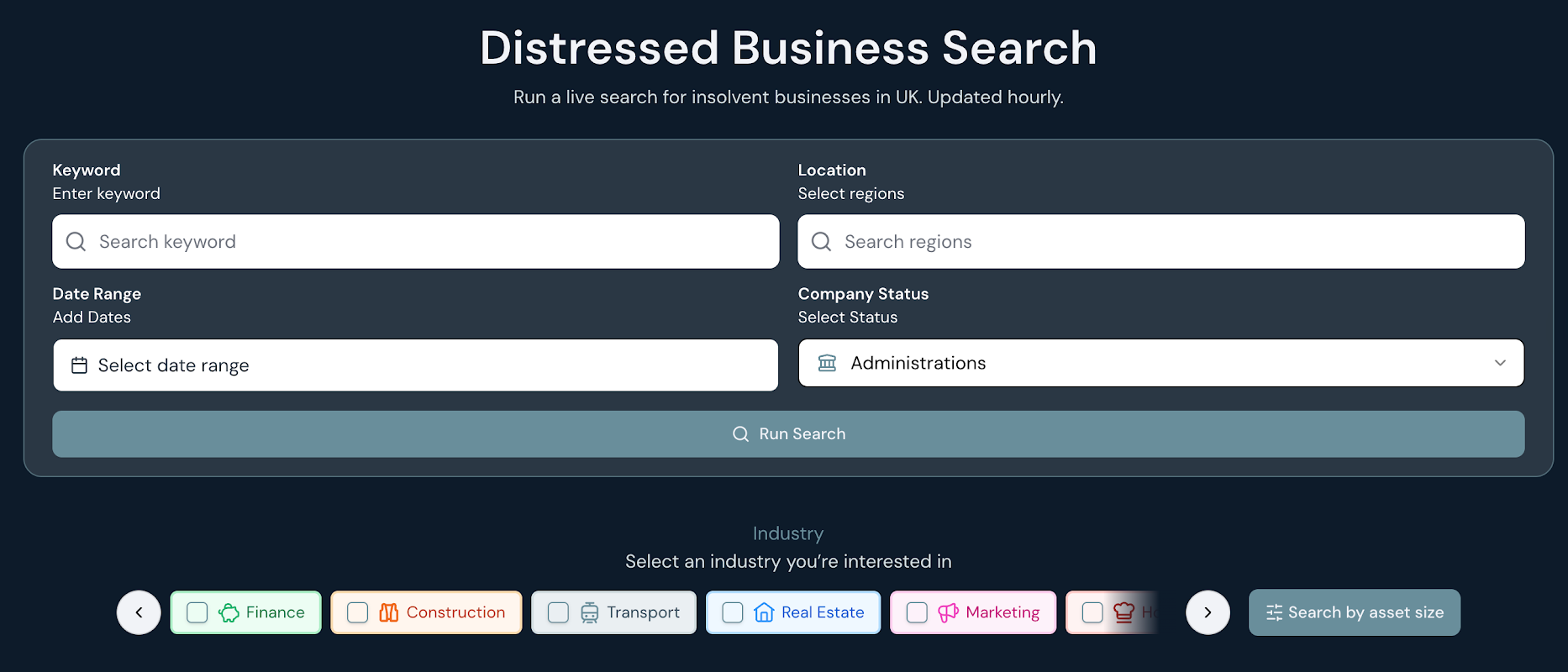
Administration List Distressed Business Search: keyword, location, date range and company status filters, with industry filters below01 FIND · 02 MONITOR
VIEW A

Search + watchlist

Search distressed UK companies, then add the ones that fit your thesis — or the criteria themselves — to a watchlist.

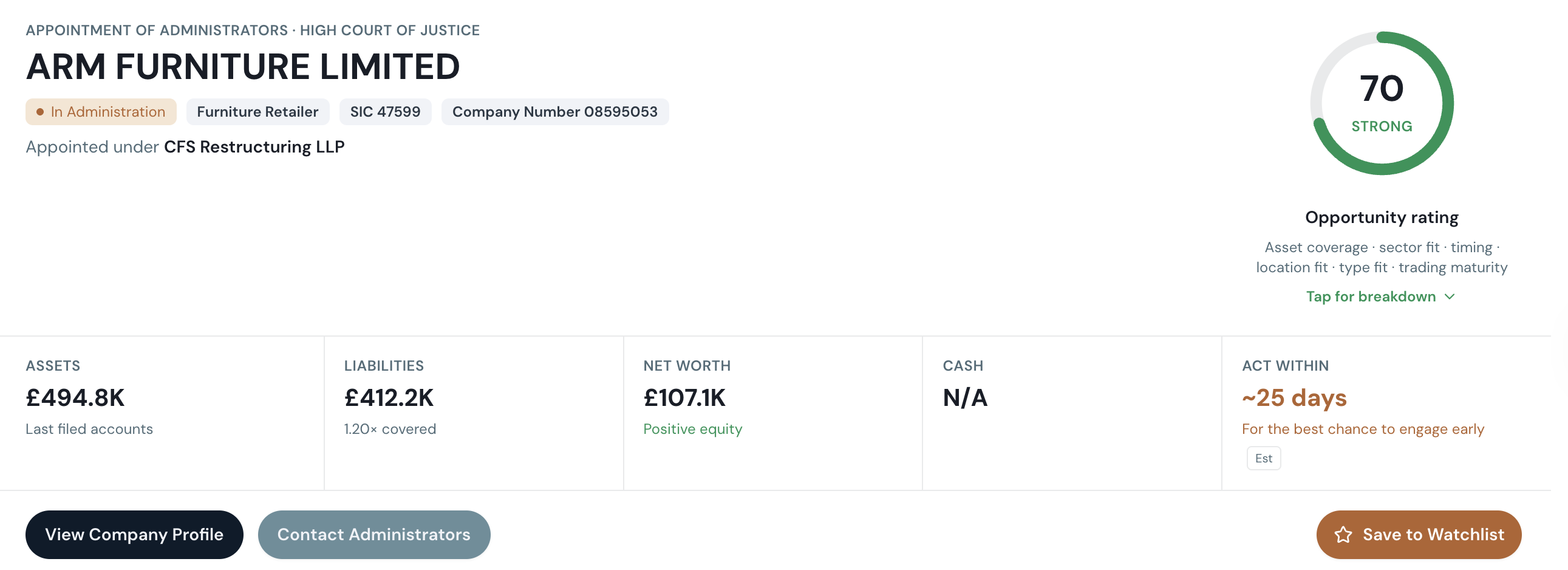
Administration List company view for ARM Furniture Limited: in administration, opportunity rating 70 (strong), assets, liabilities, net worth and an estimated 25 days to act, with a Save to Watchlist button
03 SEE EARLIER · 04 INVESTIGATE
VIEW B

Company intelligence + alerts

Alerts surface winding-up petitions and other insolvency events on monitored companies. The company view gives the financial context as the situation develops.

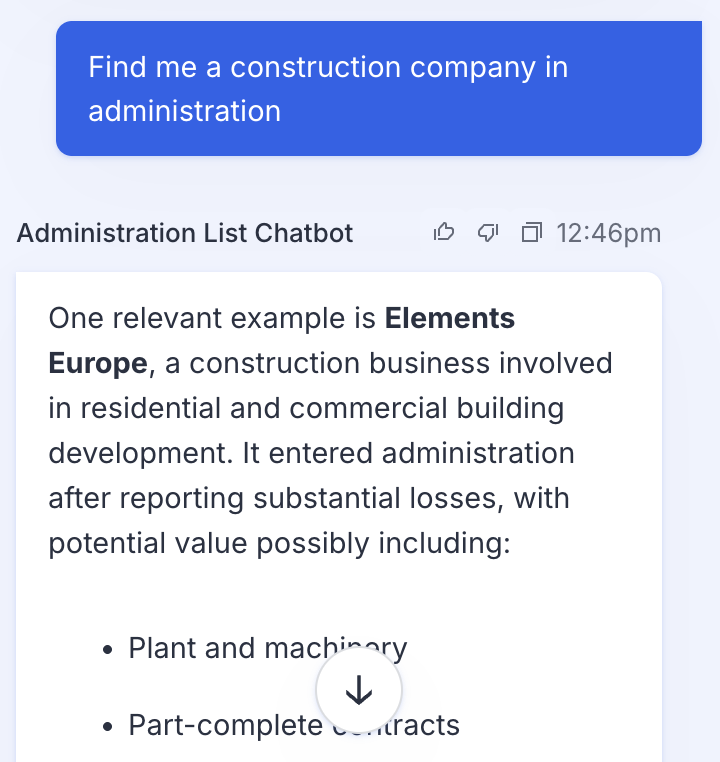
Administration List AI chatbot answering “Find me a construction company in administration” with an example company and potential assets
05 DECIDE
VIEW C

AI assistant

Ask questions, test strategic fit and refine your criteria before deciding what deserves further attention.

ILLUSTRATIVE PROMPTS
“Would this business fit an acquisition strategy focused on hospitality businesses in the South East?”
“What should I investigate before approaching the administrator?”
SIGNALS TRACKED
Winding-up petitions, administrations and liquidations
WORKFLOW
Watchlists and alerts built around your criteria
COVERAGE
UK distressed business intelligence
RESEARCH
Company intelligence, financial context and AI-assisted research
BLACK FRIDAY 2026

The 2027 DistressedAcquisition Buyer Package

Everything you need to build and monitor a distressed acquisition pipeline throughout 2027.

Black Friday happens once a year. Distressed acquisition opportunities don’t. The company that fits your criteria could encounter financial pressure in January, March or August — so this offer is built around 2027, not a few weeks.

WHAT YOU RECEIVE
01
INTELLIGENCE
12 months of Administration List access.
02
RESEARCH
The 2027 Distressed Acquisition Watchlist.
03
STRATEGY
Your personalised 2027 Acquisition Brief, plus an acquisition strategy onboarding session.
04
MONITORING
Watchlists and alerts to help monitor relevant companies and distress signals — with help configuring them.
05
DECISION SUPPORT
Administration List AI tools to help investigate companies, refine criteria and assess potential strategic fit — with guidance on using them.

THE COMPLETE PACKAGE

EARLY
ACCESS
GET FIRST ACCESS TO OUR BLACK FRIDAY OFFERUNTIL MONDAY 23 NOVEMBER

Get ahead of the public launch. Leave your details below and we’ll send you an exclusive early access discount on the complete Black Friday Acquisition Pack, including the 2027 Distressed Acquisition Watchlist and our full acquisition toolkit.

UNLOCK MY EARLY ACCESS DISCOUNT →

Your discount will arrive straight in your inbox.

Everyone’s looking for deals.
We’re looking for businesses.
SOURCES & METHODOLOGY+

This article is based primarily on Administration List data and analysis covering January–September 2026. Recent filing data can be subject to late-filing revisions. Sector percentages represent the share of recorded cases where an industry classification was available.

Winding-up petitions are distress signals. Not every petition results in administration or liquidation, and the presence of a petition does not mean a company is available for acquisition.

Administration likewise does not automatically mean that a business or its assets are available for acquisition.

Named company examples are public events used to illustrate different distress and acquisition scenarios. Potential acquisition angles represent editorial analysis rather than confirmation that a particular business or asset was marketed or available to every buyer. Their inclusion does not imply that Administration List or an Administration List subscriber participated in a transaction.

This article is intended as acquisition intelligence and does not constitute financial, legal or investment advice.

Criteria received

Thanks for submitting your criteria!

Our customer success team will reach out to discuss this further.

Your acquisition brief is on its way to .

Book a demo